
Near-horizon perturbation of Kerr black holes

We derive a convergent source term for linear gravitational perturbation associate with the spin s=+2 perturbation
We validate the derivation by calculating the shear perturbation and the fluxes of a generic EMRI. Both of results agree with previous calculation in Teukolsky formalism very well.
See GeneralizedSasakiNakamura.jl for our code implementation.
See arXiv:2512.07937 for details.
High performance EMRI waveform generation based on Sasaki-Nakamura formalism

- Benefiting from the short-range nature of the Sasaki–Nakamura (SN) formalism, we can use it to compute gravitational-wave waveforms from point particles on both bound and unbound orbits.
- The difficulties in solving the inhomogeneous SN source term and evaluating the Green’s function integral can be avoided by applying the integration-by-parts (IBP) technique.
- See GeneralizedSasakiNakamura.jl for our code implementation.
See arXiv:2511.08673 for details.
Binary extreme-mass-ratio inspiral (b-EMRI) waveform modeling
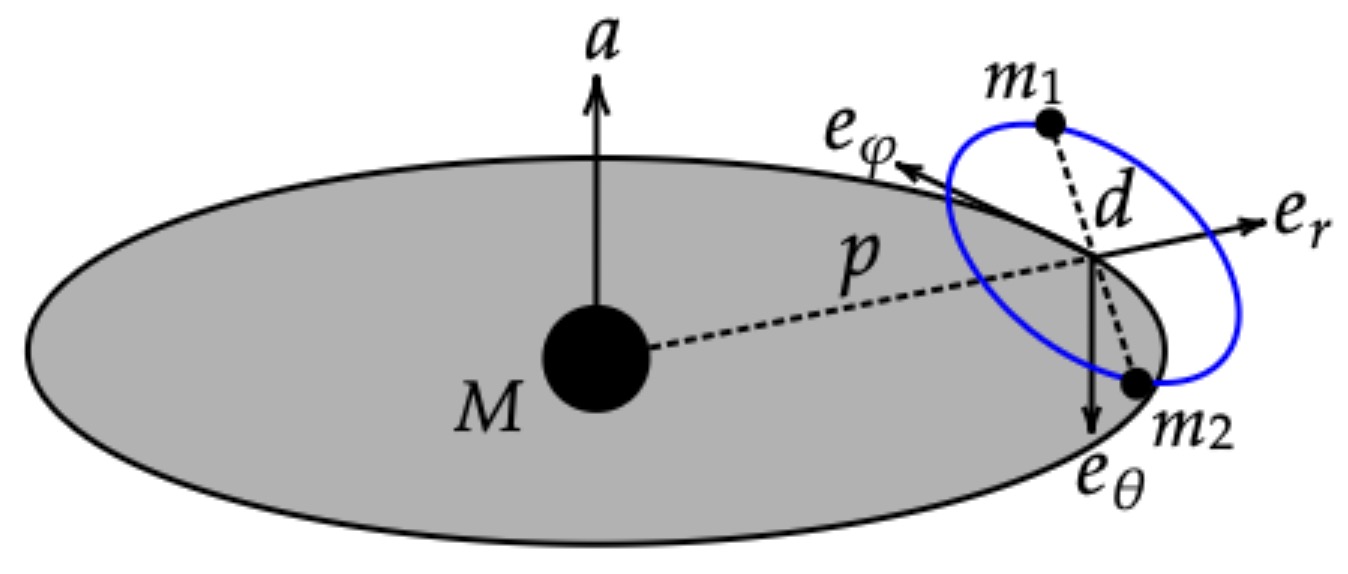
B-EMRIs are hierarchical triple systems consisting of a supermassive bleck hole (SMBH) and two staller mass black holes.
We carried out a waveform model based on black hole perturbation theory and relativistic three-body dynamics.
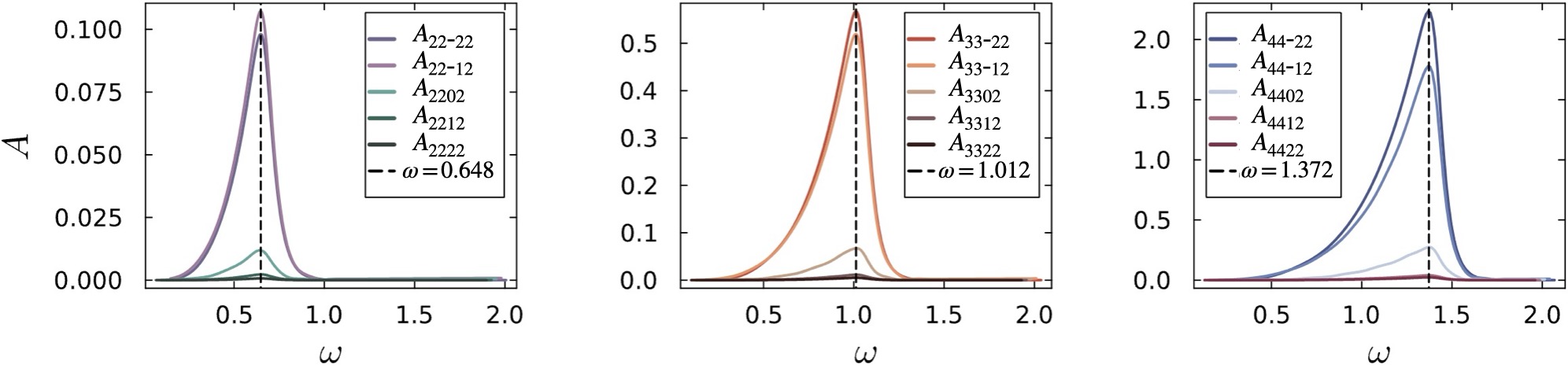
What’s interesting is that the small binary could resonantly excite the quasi-normal modes of the SMBH, leading to some distinguishable features.
See Phys. Rev. D 111. 103007 for details.